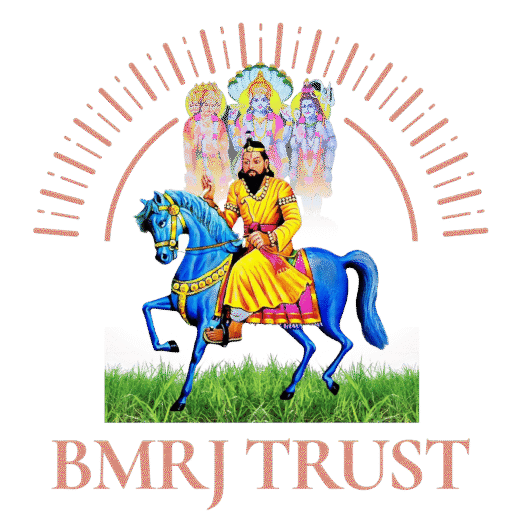
About Baba Mohan Ram Ji
Baba Mohan Ram Ji is revered by devotees as a spiritual guide whose life and teachings illuminate the path of truth, humility, and righteous living. His message emphasizes inner discipline, moral clarity, and devotion expressed through everyday conduct, encouraging individuals to live with integrity, compassion, and responsibility toward society.
Deeply associated with the sacred Milakpur Kali Kholi Dham, Baba Mohan Ram Ji’s presence continues to inspire seekers to remain rooted in dharma while navigating life’s challenges. His teachings remind devotees that true devotion is not confined to ritual, but reflected through selfless service, humility, and a balanced, purposeful way of life.
Core Teachings & Spiritual Message:
- Truth (Satya) & Live with honesty and integrity in thought, speech, and action, for truth is the highest form of devotion.
- Humility (Vinamrata): Cultivate a life free from ego, recognizing that all service is an offering to the divine.
- Selfless Service (Seva) Embrace seva as the purest expression of faith—serving humanity without expectation or attachment.
- Faith (Bhakti):Strengthen devotion through remembrance, discipline, and steadfast belief in divine grace.
- Righteous Living (Dharma): Walk the path of moral conduct, compassion, and responsibility toward society and all living beings.
Knowledge and Wisdom
- Wisdom Rooted in Truth (Satya): Baba Mohan Ram Ji’s teachings reflect profound spiritual understanding grounded in truth, devotion, and selfless seva—offering moral clarity and inner strength to devotees.
- Guidance Through Sacred Traditions: His insights into spiritual practices and age-old traditions help devotees strengthen faith, overcome uncertainty, and live with discipline and confidence on the path of dharma.
- Wisdom Shared Through Satsang and Bhajans: Through satsang, bhajans, and sacred narratives associated with Baba Ji, ancient spiritual wisdom is preserved and passed on—making divine knowledge accessible to devotees of all ages.
Importance in Devotees’ Lives
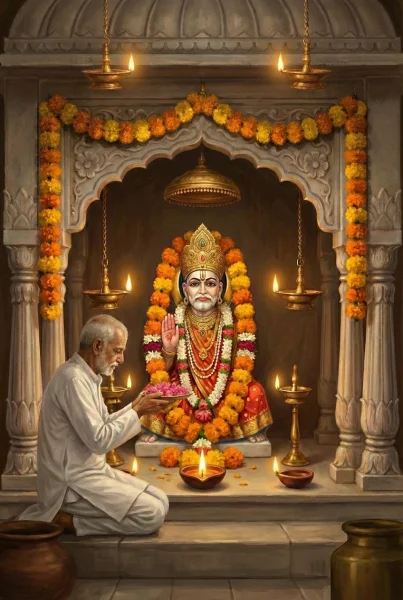
In the lives of devotees, spiritual guidance plays a vital role in shaping thought, conduct, and inner discipline. Through reflection, shared wisdom, and lived teachings, devotees find clarity during moments of doubt and strength to face life’s challenges with faith and balance. Guidance rooted in the life and message of Baba Mohan Ram Ji helps individuals cultivate inner peace, moral clarity, and steadfast devotion. His teachings gently guide devotees to integrate spiritual values into everyday actions and decisions—encouraging a life rooted in responsibility, compassion, and righteousness.
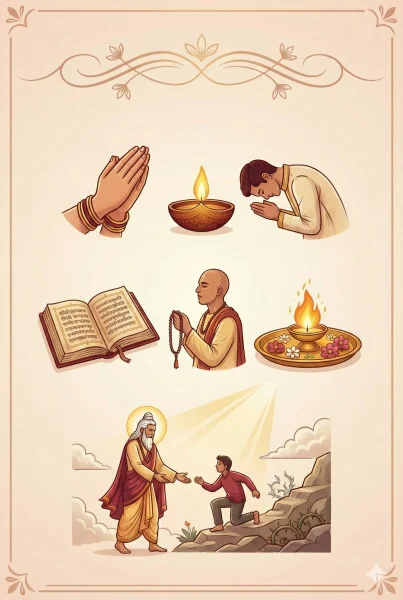
Baba Mohan Ram Ji’s life, teachings, and divine grace continue to inspire seekers on the path of truth and righteous living. Sacred traditions such as satsang, aarti, bhajans, and remembrance strengthen faith, dispel uncertainty, and nurture disciplined devotional practice within the community. Through these timeless practices, spiritual wisdom is lovingly preserved and shared—ensuring that its guidance remains accessible, relevant, and alive for present and future generations.
Support & Clarity in Difficult Times
Guidance for Devotees
The Story Of Nandu and baba Mohan Ram Ji
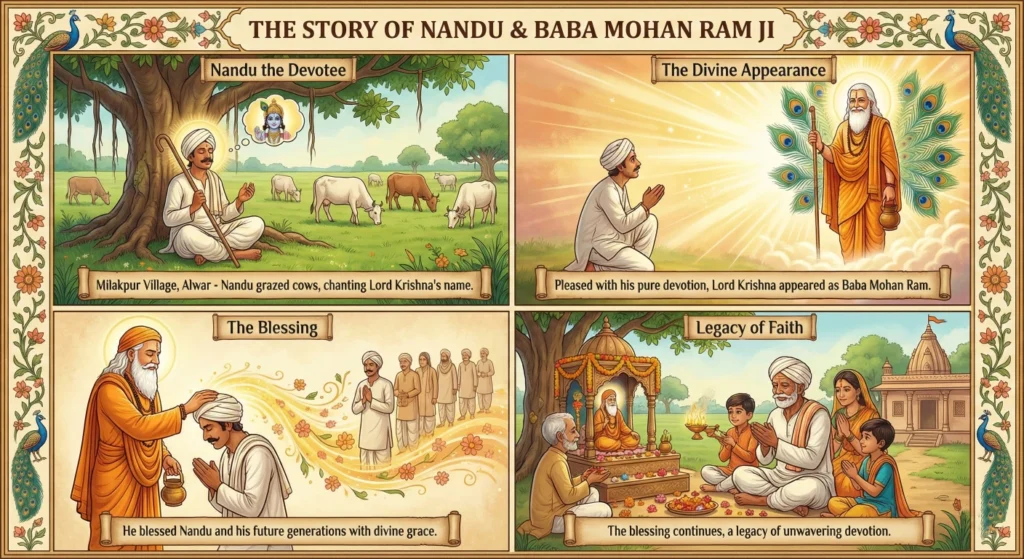
Around 1530 CE, in the village of Milakpur in present-day Alwar district, Rajasthan, lived a humble Brahmin cowherd named Nandu. Simple in nature and pure in heart, Nandu spent his days grazing cows while continuously chanting the name of Lord Krishna. His life was marked by unwavering devotion, humility, and complete surrender to divine will. Nandu’s bhakti was free from desire or expectation. Whether alone in the fields or beneath the shade of trees, his mind remained absorbed in remembrance. It is believed that his sincere devotion pleased the divine so deeply that the Lord chose to reveal Himself to this faithful devotee.
One day, a divine cow appeared among Nandu’s herd and gently led him toward a cave in the Kali Kholi hills. There, Nandu encountered a radiant sage immersed in deep meditation. Through this sacred meeting, the sage revealed Himself as Baba Mohan Ram Ji, whom devotees believe to be a divine manifestation of Lord Krishna, and blessed Nandu for his unwavering devotion and purity of heart. Baba Mohan Ram Ji bestowed profound blessings upon Nandu, assuring divine grace upon his lineage, the lighting of an Akhand Jyoti (eternal flame) at this sacred place, and continued blessings for all devotees who approach with faith and sincerity. From that moment, Nandu renounced worldly attachments and dedicated his life entirely to seva and worship, establishing the first place of devotion that would later be revered as Milakpur Kali Kholi Dham.
The Story Of Nandu and Baba Mohan Ram Ji
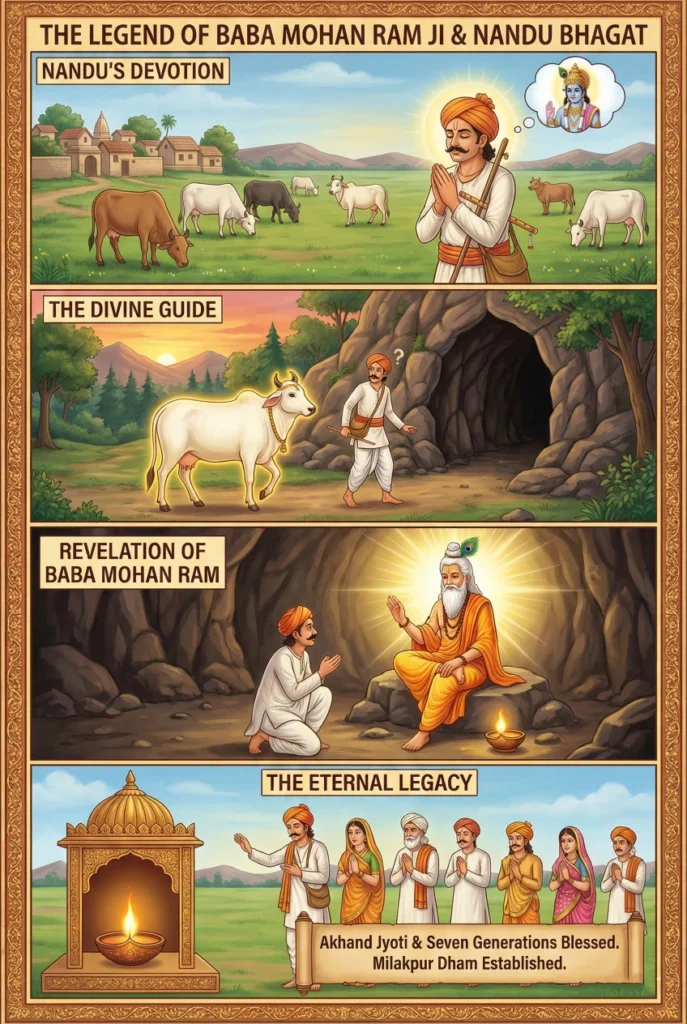
Around 1530 CE, in the village of Milakpur in Alwar district, Rajasthan, there lived a humble Brahmin cowherd named Nandu who spent his days grazing cows while immersed in constant devotion to Lord Krishna. His pure-hearted bhakti was so sincere that Lord Krishna decided to reveal Himself to this faithful devotee.
One day, a divine cow appeared among Nandu’s herd and led him to a cave in the Kali Kholi hills, where he discovered a radiant sage deep in meditation. The sage revealed Himself as Baba Mohan Ram—a divine manifestation of Lord Krishna—and blessed Nandu as His first and foremost devotee. Baba Mohan Ram bestowed sacred boons upon Nandu: his seven generations would be blessed, an Akhand Jyoti (eternal flame) should be lit at this holy place, and all who came seeking blessings through his lineage would have their prayers answered. From that day, Nandu renounced worldly life and devoted himself entirely to serving Baba Mohan Ram Ji, establishing the first place of worship that became today’s revered Milakpur Kali Kholi Dham.
The Appearance at Kholi Dham
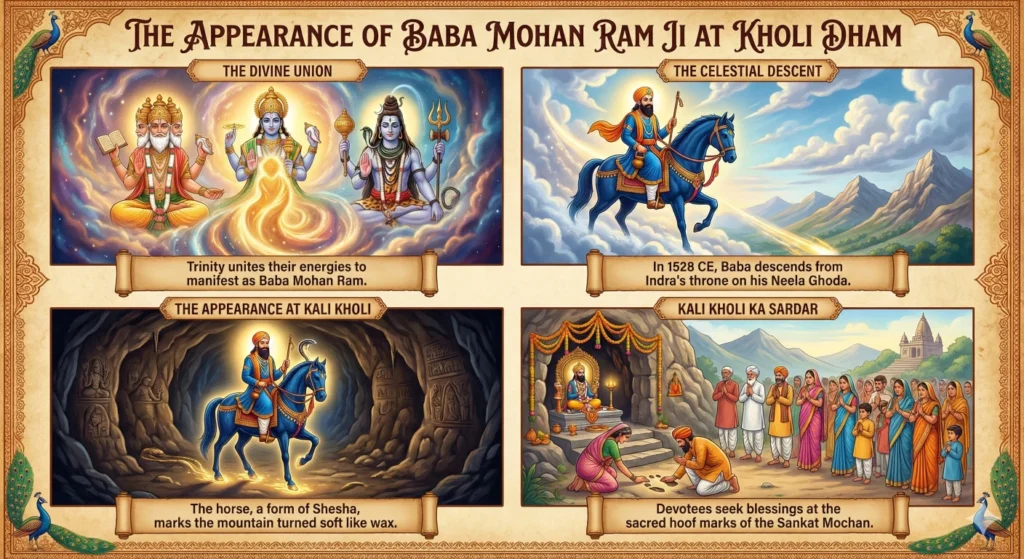
According to sacred tradition, during a time of declining dharma on earth, the Holy Trinity—Brahma, Vishnu, and Mahesh (Shiva)—combined their divine energies and manifested as one unified being in the form of Baba Mohan Ram Ji. In 1528 CE, he descended from Indra’s heavenly throne and appeared riding a magnificent neela ghoda (blue horse) in the sacred cave of Kali Kholi, nestled in the Aravalli hills near present-day Bhiwadi. The blue horse, believed to be a manifestation of Shesha the divine serpent, left its hoof prints permanently imprinted on the rocks—legend says the mountain turned soft like wax under the celestial hooves.
As the Kali Kholi ka Sardar (Lord of the Dark Cave), Baba Mohan Ram Ji established his divine seat in this remote sanctuary, becoming a sankat mochan (remover of troubles) and savior for all who approached with sincere faith, regardless of caste or background. Devotees still visit the cave to witness these sacred hoof marks and seek blessings from the place where the divine Trinity first touched earth in this unified form.
The Appearance at Kholi Dham
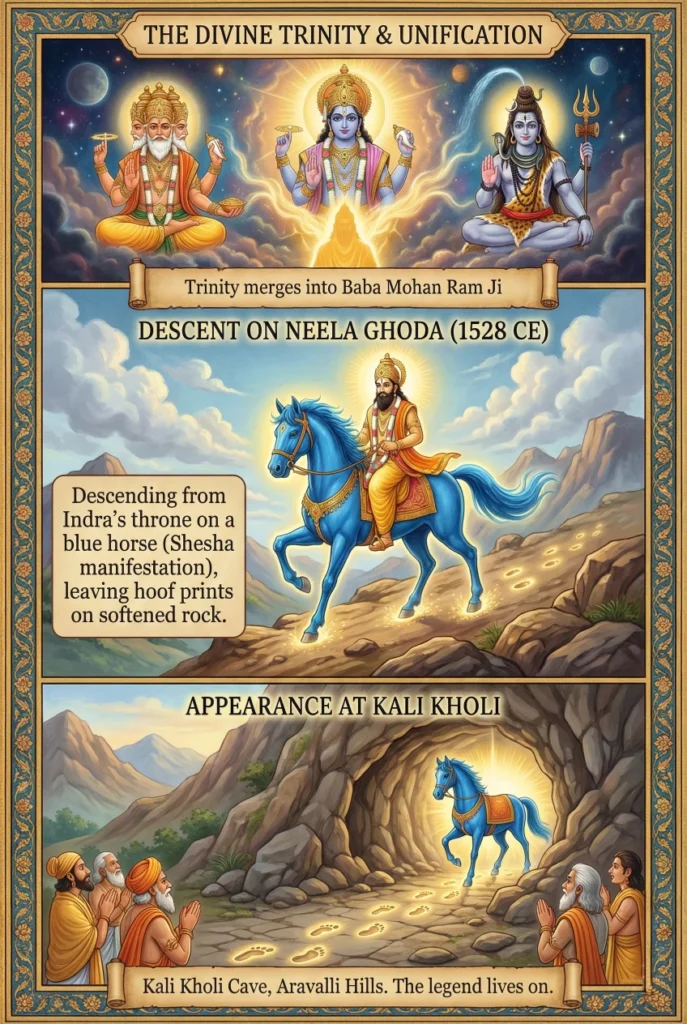
According to sacred tradition, during a time of declining dharma on earth, the Holy Trinity—Brahma, Vishnu, and Mahesh (Shiva)—combined their divine energies and manifested as one unified being in the form of Baba Mohan Ram Ji. In 1528 CE, he descended from Indra’s heavenly throne and appeared riding a magnificent neela ghoda (blue horse) in the sacred cave of Kali Kholi, nestled in the Aravalli hills near present-day Bhiwadi. The blue horse, believed to be a manifestation of Shesha the divine serpent, left its hoof prints permanently imprinted on the rocks—legend says the mountain turned soft like wax under the celestial hooves.
As the Kali Kholi ka Sardar (Lord of the Dark Cave), Baba Mohan Ram Ji established his divine seat in this remote sanctuary, becoming a sankat mochan (remover of troubles) and savior for all who approached with sincere faith, regardless of caste or background. Devotees still visit the cave to witness these sacred hoof marks and seek blessings from the place where the divine Trinity first touched earth in this unified form.
The Divine Cow Miracle
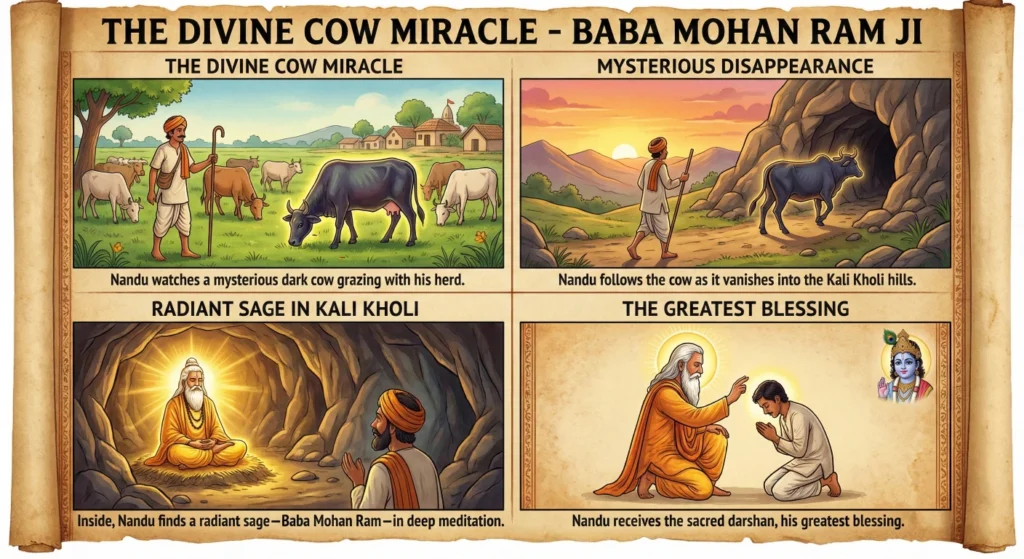
One day, while Nandu was tending his herd near Milakpur, a mysterious dark-colored cow began appearing among his cattle each morning, grazing peacefully but mysteriously disappearing into the hills each evening. After several months, Nandu decided to follow the cow and watched it enter a cave deep in the Kali Kholi hills.
Inside, he discovered a radiant sage immersed in meditation, surrounded by brilliant divine light. The sage revealed himself as Baba Mohan Ram—the manifestation of Lord Krishna whom Nandu had worshipped his entire life—praising Nandu for unknowingly caring for this divine cow. When offered any boon, Nandu humbly replied that the sacred darshan itself was the greatest blessing he could receive.
The Divine Cow Miracle
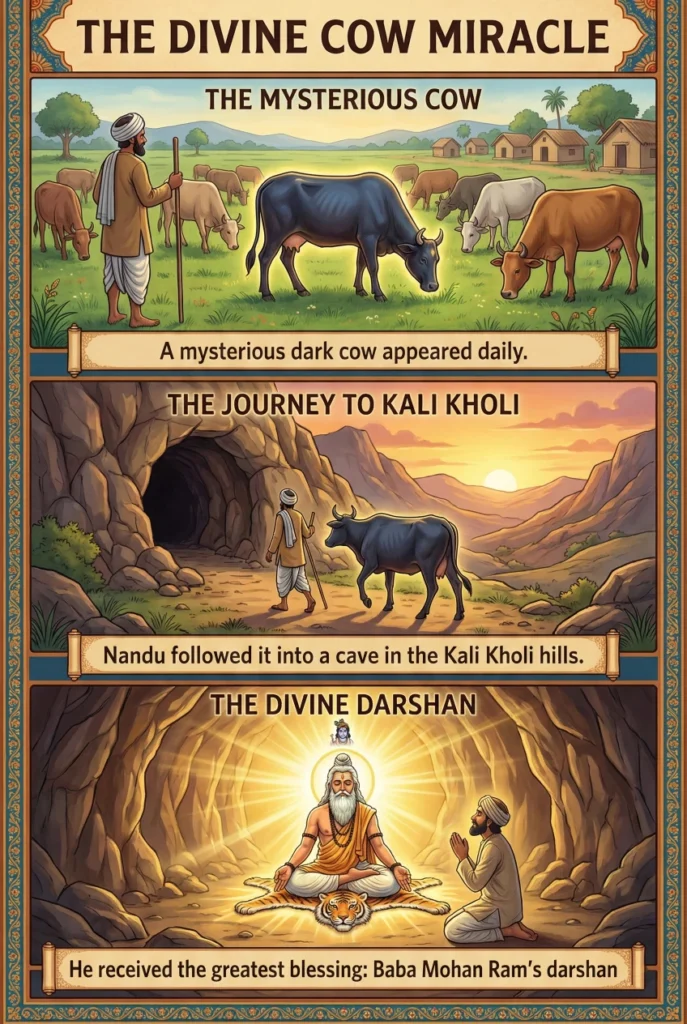
One day, while Nandu was tending his herd near Milakpur, a mysterious dark-colored cow began appearing among his cattle each morning, grazing peacefully but mysteriously disappearing into the hills each evening. After several months, Nandu decided to follow the cow and watched it enter a cave deep in the Kali Kholi hills.
Inside, he discovered a radiant sage immersed in meditation, surrounded by brilliant divine light. The sage revealed himself as Baba Mohan Ram—the manifestation of Lord Krishna whom Nandu had worshipped his entire life—praising Nandu for unknowingly caring for this divine cow. When offered any boon, Nandu humbly replied that the sacred darshan itself was the greatest blessing he could receive.
The Construction of Milakpur Temple
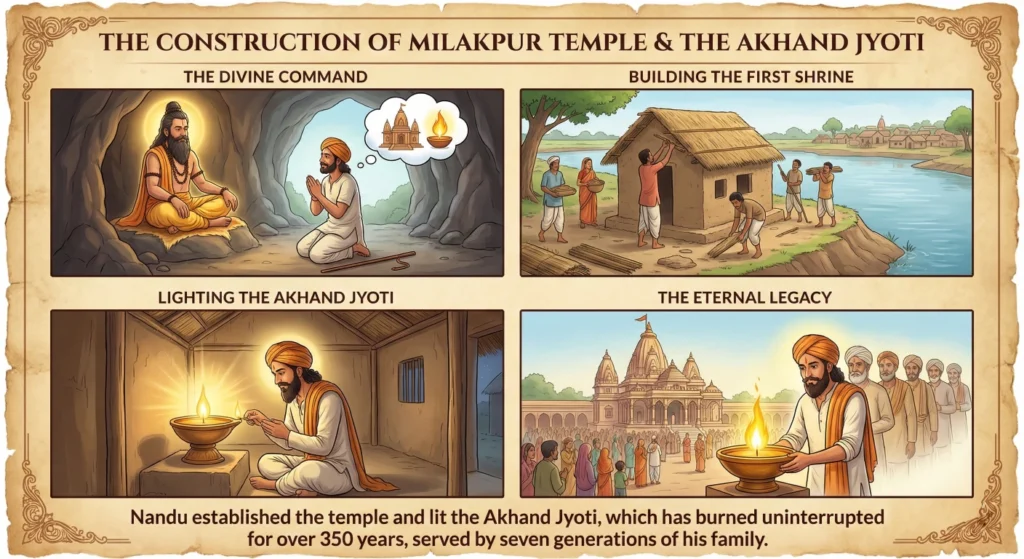
After revealing himself to Nandu in the Kali Kholi cave, Baba Mohan Ram commanded his devotee to build a temple in his name in the village of Milakpur, where Nandu lived. Following this divine instruction, Nandu (also known as Lallu Bhagat in some traditions) established the first place of worship on the embankment of the johad (water reservoir) near Milakpur village, building a simple kutiya (hut) where he could continue his devotion and service.
At this sacred site, Nandu lit the Akhand Jyoti (eternal flame) as commanded by Baba Mohan Ram Ji, symbolizing the continuous divine presence and protection. This sacred flame has been burning uninterrupted for over 350 years, maintained lovingly by seven generations of Nandu’s descendants who continue to serve as pujaris and caretakers of the temple. What began as a humble kutiya gradually transformed into the revered Milakpur Temple complex that draws millions of devotees annually, with the Akhand Jyoti remaining the spiritual heart of the Dham.
The Construction of Milakpur Temple
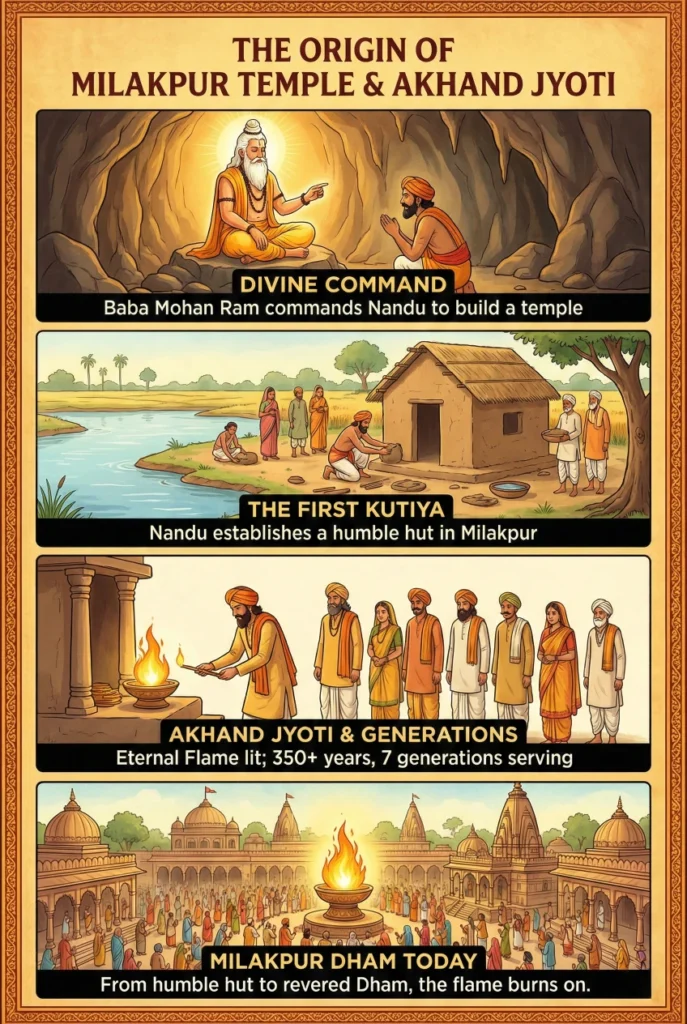
After revealing himself to Nandu in the Kali Kholi cave, Baba Mohan Ram commanded his devotee to build a temple in his name in the village of Milakpur, where Nandu lived. Following this divine instruction, Nandu (also known as Lallu Bhagat in some traditions) established the first place of worship on the embankment of the johad (water reservoir) near Milakpur village, building a simple kutiya (hut) where he could continue his devotion and service.
At this sacred site, Nandu lit the Akhand Jyoti (eternal flame) as commanded by Baba Mohan Ram Ji, symbolizing the continuous divine presence and protection. This sacred flame has been burning uninterrupted for over 350 years, maintained lovingly by seven generations of Nandu’s descendants who continue to serve as pujaris and caretakers of the temple. What began as a humble kutiya gradually transformed into the revered Milakpur Temple complex that draws millions of devotees annually, with the Akhand Jyoti remaining the spiritual heart of the Dham.
The Eternal Flame and Divine Feast
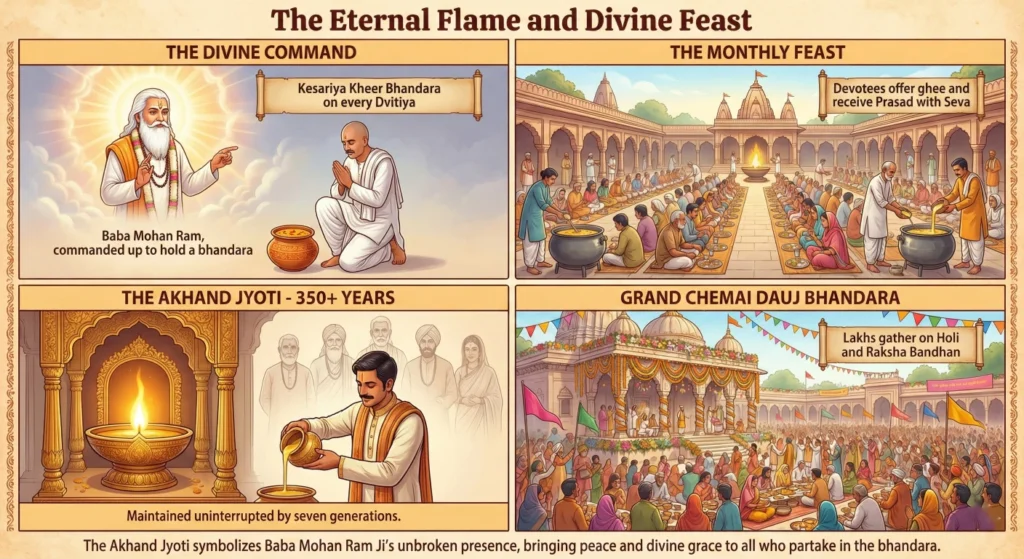
Following Baba Mohan Ram Ji’s divine command, Nandu established the sacred tradition of holding a bhandara (communal feast) with kesariya kheer on every Dvitiya or Dauj (the second day after Amavasya in the lunar calendar). This monthly observance became a cornerstone of devotion at Milakpur, with devotees offering ghee to the Akhand Jyoti, receiving prasad, and participating in collective seva. The tradition reaches its peak during Chemai Dauj—the six-monthly observances on Holi and Raksha Bandhan—when lakhs of devotees gather for the grand bhandara.
At the heart of this tradition burns the Akhand Jyoti, the eternal flame that Nandu lit over 350 years ago, symbolizing Baba Mohan Ram Ji’s unbroken presence. Maintained continuously by seven generations of Nandu’s descendants, this sacred flame has burned day and night without interruption, marking Kholi Dham as a place where divine light never dims. Devotees believe that offering ghee to this jyoti and partaking in bhandara prasad brings peace, removes obstacles, and ensures divine grace.
The Eternal Flame and Divine Feast
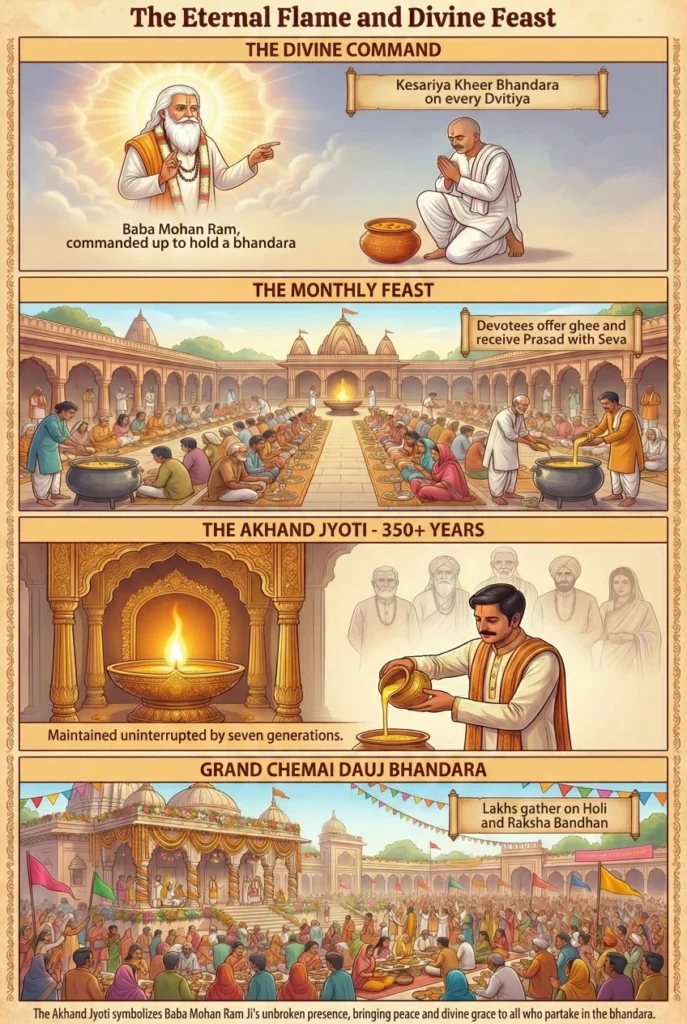
Following Baba Mohan Ram Ji’s divine command, Nandu established the sacred tradition of holding a bhandara (communal feast) with kesariya kheer on every Dvitiya or Dauj (the second day after Amavasya in the lunar calendar). This monthly observance became a cornerstone of devotion at Milakpur, with devotees offering ghee to the Akhand Jyoti, receiving prasad, and participating in collective seva. The tradition reaches its peak during Chemai Dauj—the six-monthly observances on Holi and Raksha Bandhan—when lakhs of devotees gather for the grand bhandara.
At the heart of this tradition burns the Akhand Jyoti, the eternal flame that Nandu lit over 350 years ago, symbolizing Baba Mohan Ram Ji’s unbroken presence. Maintained continuously by seven generations of Nandu’s descendants, this sacred flame has burned day and night without interruption, marking Kholi Dham as a place where divine light never dims. Devotees believe that offering ghee to this jyoti and partaking in bhandara prasad brings peace, removes obstacles, and ensures divine grace.